Video Series

Entropy Explains

Portrait of Simon Harrer

Created and narrated by Dr. Simon Harrer

Co-Founder & CEO, Entropy Data

Entropy Explains is a series of short animated explainers on data contracts, data products, and semantics. Each episode explains one concept in under three minutes, with animations instead of slides.

Coming next

  • The Open Data Contract Standard from Bitol: answers “What is the Open Data Contract Standard?” Why data contracts need a standard, how ODCS grew into a Bitol project under the Linux Foundation, and what its sections describe, from the fundamentals and the schema to the AI context in v3.2.

Subscribe to the Entropy Explains playlist or the Entropy Explains newsletter on LinkedIn to get new episodes.

Episodes

Entropy Explains, episode 13: Four Open Standards for Data Management
Episode 13 · 1:49

Four Open Standards for Data Management

Answers: “Which open standards describe your data, and how do they fit together?”

Define once, use everywhere only works if every tool reads the same files. Four open standards make that possible on three levels: ODPS describes the data product, ODCS its data contracts, and Apache Ossie the semantic models and the ontology. Each contract column points to the business concept it implements.

Watch on YouTube Read as annotated slides

Entropy Explains, episode 12: The Value of Data Products, Contracts, and Semantics: For Managers
Episode 12 · 2:17

The Value of Data Products, Contracts, and Semantics: For Managers

Answers: “How to get budget for Data Products, Data Contracts, and semantics?”

Your data lives on several platforms, but nobody has a shared, verified definition of what it means, how good it is, or what it may be used for, and now AI agents use it across the company. Data products give data an owner, data contracts a promise that is checked every day, and semantics one shared meaning. Defined once, the definitions are pushed to Databricks, Snowflake, and Google Cloud, on open standards that are mature today.

Watch on YouTube Read as annotated slides

Entropy Explains, episode 11: Data Contract Best Practices
Episode 11 · 2:58

Data Contract Best Practices

Answers: “What are the best practices for data contracts?”

A contract per table sounds thorough, but you end up with too many contracts. Keep one data contract in one major version for one output port, with one database schema and one read role. Keep it in the data product's Git repository, version it like an API, run v2 next to v1 for a grace period, and treat the active contract as the source of truth.

Watch on YouTube Read as annotated slides

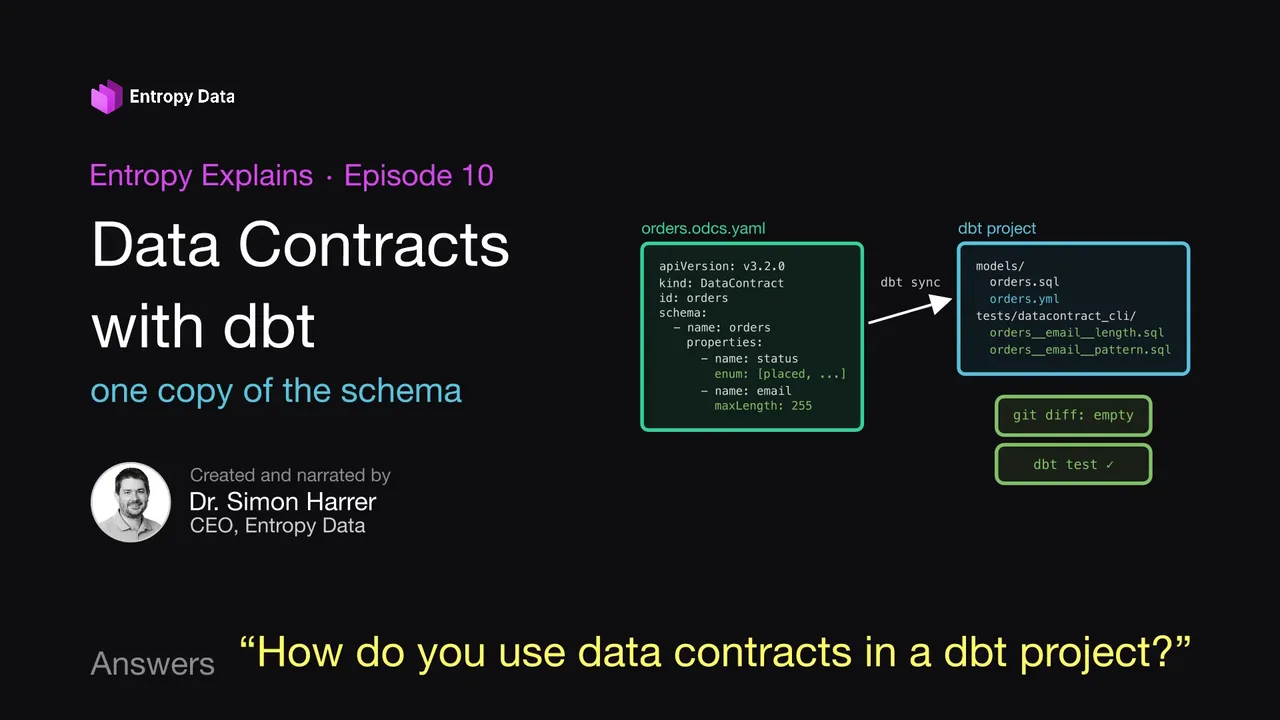
Entropy Explains, episode 10: Data Contracts with dbt
Episode 10 · 2:24

Data Contracts with dbt

Answers: “How do you use data contracts in a dbt project?”

If you write a data contract by hand next to your dbt model, you keep two copies of the schema, and they drift apart. Import the first contract from the dbt manifest, then let the Data Contract CLI sync it into your project as properties and tests. In CI, a second sync must change nothing, and dbt test reports the results in the words of the contract.

Watch on YouTube Read as annotated slides

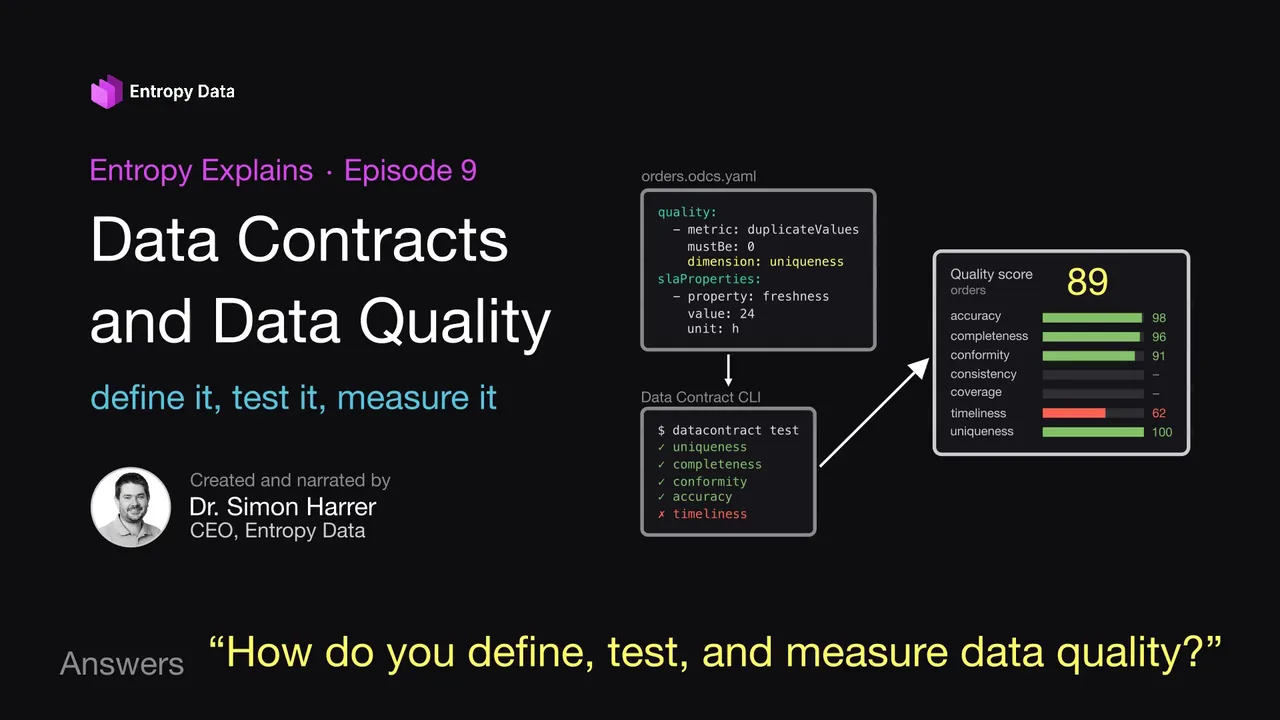
Entropy Explains, episode 9: Data Contracts and Data Quality
Episode 9 · 2:56

Data Contracts and Data Quality

Answers: “How do you define, test, and measure data quality?”

Revenue doubled overnight because of duplicate rows, and nobody had written down that order IDs must be unique. Capture quality rules in plain language with the business and the data consumers, turn them into SQL checks and library metrics with AI, and put them into the data contract together with the SLAs. The Data Contract CLI tests them in CI and on a schedule, and a quality score by dimension shows where quality is weak.

Watch on YouTube Read as annotated slides

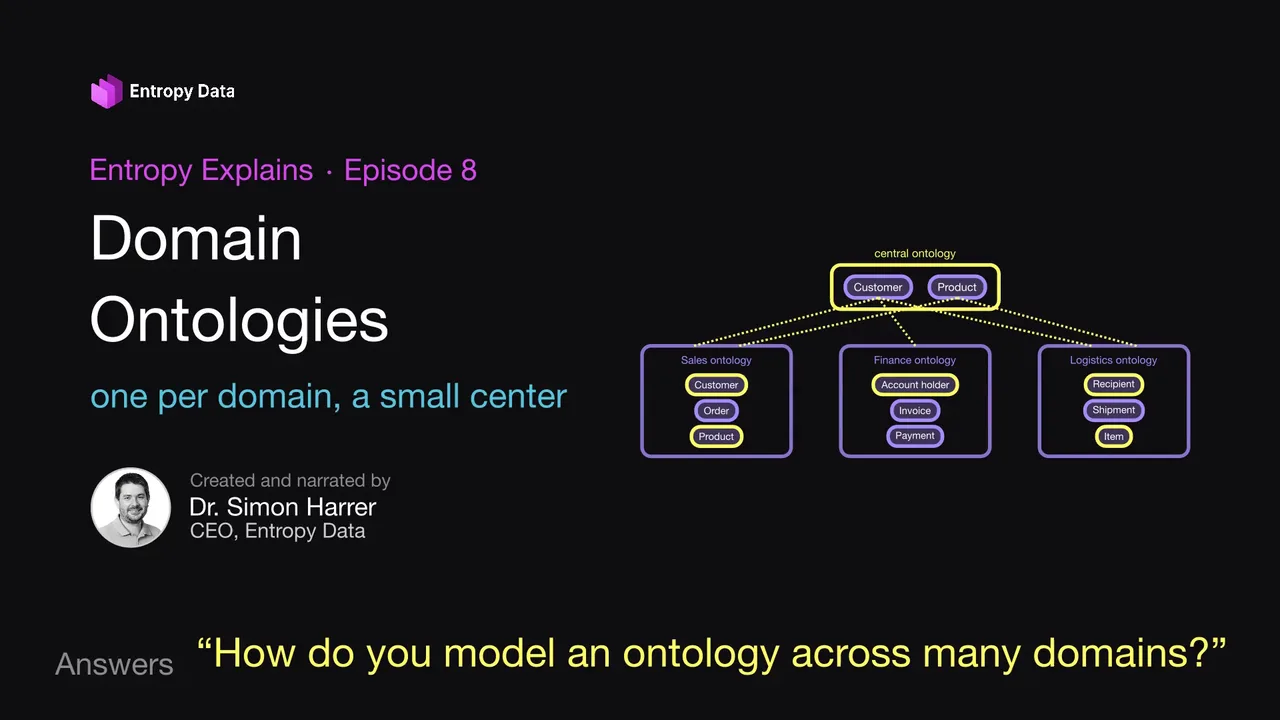
Entropy Explains, episode 8: Domain Ontologies
Episode 8 · 2:13

Domain Ontologies

Answers: “How do you model an ontology across many domains?”

One ontology for the whole company sounds tidy, but every change needs every domain to agree. Model one ontology per domain, owned by the domain team. Link the domains directly while there are few; once there are many, a small central ontology links only the shared concepts, and AI agents follow it across domains to the linked data contracts.

Watch on YouTube Read as annotated slides

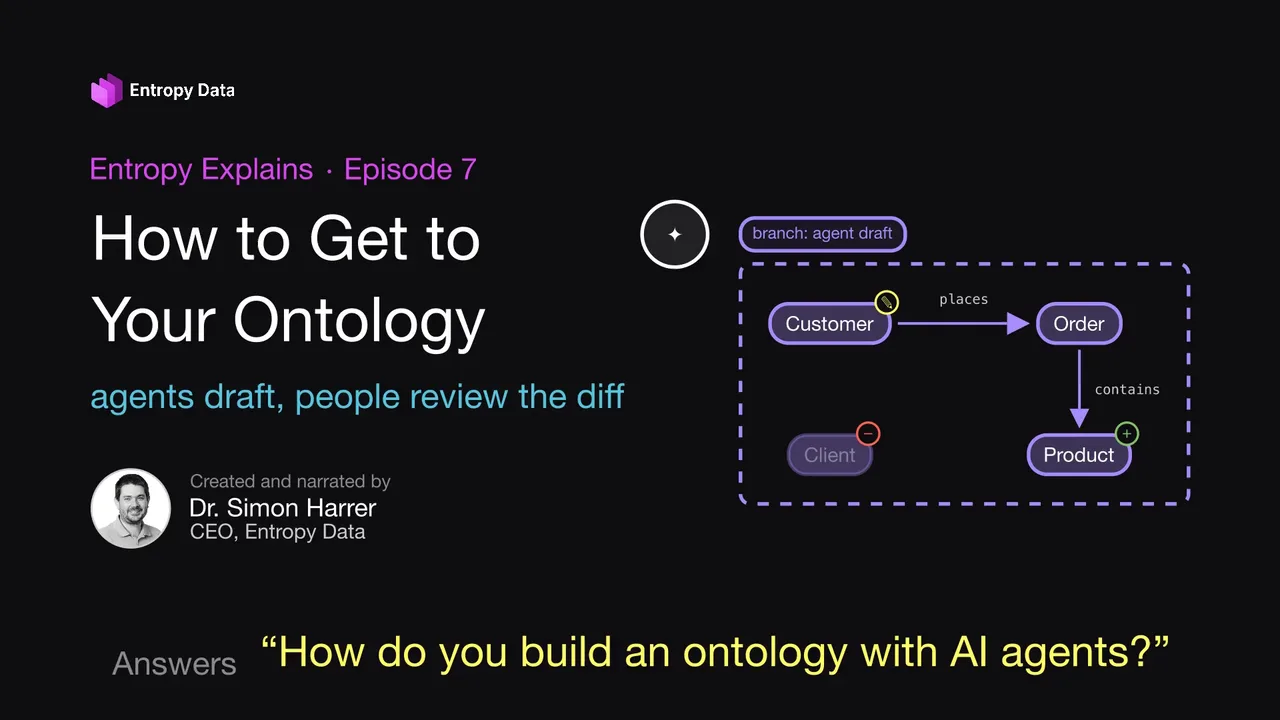
Entropy Explains, episode 7: How to Get to Your Ontology
Episode 7 · 2:31

How to Get to Your Ontology

Answers: “How do you build an ontology with AI agents?”

Business people and AI agents both need an ontology, and nobody wants to wait through months of workshops for one. Capture what the business already knows, let an agent draft concepts and relationships on a branch, and let business people review the diff in the diagram, a few rounds, before the merge. Already in use? The blast radius shows which data contracts and owners a change affects.

Watch on YouTube Read as annotated slides

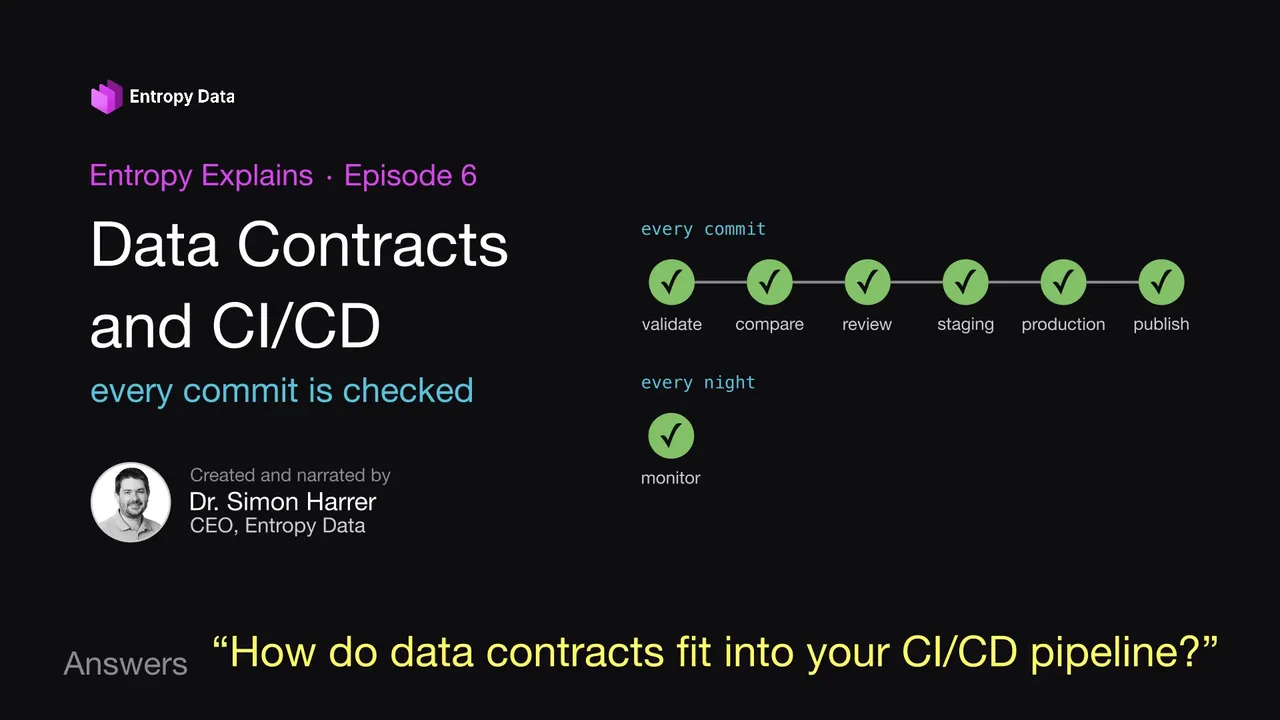
Entropy Explains, episode 6: Data Contracts and CI/CD
Episode 6 · 2:40

Data Contracts and CI/CD

Answers: “How do data contracts fit into your CI/CD pipeline?”

One renamed column, three broken consumers, and the data contract knew. Keep it in Git next to the pipeline code and check every pull request with the Data Contract CLI: lint, your own rules, breaking changes, and tests in an isolated environment. After the merge, test in staging and production and publish. Every night, promise monitoring tests production.

Watch on YouTube Read as annotated slides

Entropy Explains, episode 5: Put Your Data Under Contract
Episode 5 · 1:56

Put Your Data Under Contract

Answers: “How do you put an existing table under a data contract?”

Your table has been in production for years, and there is no data contract. Import it with the Data Contract CLI, test it right away for a green baseline, and add what only you know: a description, a classification, a quality rule, a freshness promise, and an owner. You go data-first once, then the contract leads.

Watch on YouTube Read as annotated slides

Entropy Explains, episode 4: Building Data Products with AI
Episode 4 · 2:08

Building Data Products with AI

Answers: “How do you build a data product with AI?”

Nobody writes data pipelines by hand anymore. A coding agent builds the data product contract-first, from three inputs: a data contract as the what, defined together in a workshop, skills with your conventions as the how, and a data marketplace as the data to build on.

Watch on YouTube Read as annotated slides

Entropy Explains, episode 3: Data Contracts and Semantics
Episode 3 · 2:18

Data Contracts and Semantics

Answers: “How do AI agents know what your data means?”

Model the meaning once: an ontology with entities, properties, and relationships, captured in Apache Ossie. Link data contract columns to its concepts so they inherit description and classification, and let AI agents use that anchoring to know how to join data, and what to leave out.

Watch on YouTube Read as annotated slides

Entropy Explains, episode 2: Data Contracts and Data Products
Episode 2 · 2:38

Data Contracts and Data Products

Answers: “What is a data product, and how does it relate to data contracts?”

A data product is more than just data: data, code, and metadata as one unit, owned by one team. How it lives in Git as an Open Data Product Standard (ODPS) file, is published to a data marketplace, and moves from v1 to v2 without outages.

Watch on YouTube Read as annotated slides

Entropy Explains, episode 1: Data Contracts
Episode 1 · 2:30

Data Contracts

Answers: “What is a data contract, and why do you need one?”

Why data consumers break when data changes, what goes into a data contract in the Open Data Contract Standard (ODCS), and how the open-source Data Contract Editor and Data Contract CLI keep the promise.

Watch on YouTube Read as annotated slides